OSTRACISM – OSTRAKON II
From Ancient Athens to Contemporary Forms of Exclusion
Participating artists: Aggelos Antonopoulos, Kostis Velonis, Babis Venetopoulos, Andreas Vousouros, Vasilis Gerodimos, Vaggelis Gokas, Giorgos Gyparakis, Charalambos Dermatis, Sofia Zarari, Anestis Ioannou, Giorgos Kazazis, Nikos Kanoglou, Jason Karaindros, Leonidas Karampinis, Aris Katsilakis, Panagiotis Kefalas, Aggeliki Loi, Dimitris Mastoropoulos, Ioannis Melanitis, Manolis Merabeliotis, Maro Michalakakos, Stavroula Michalopoulou, Kyriakos Mortarakos, Panagiotis Nezis, Aggelos Papadimitriou, Nikos Papadimitriou, Spyroula Politi, Artemis Potamianou, Tasos Sargentsi, Nikos Sepetzoglou, Panagiotis Siagris, Matina Stavropoulou, Maira Stefou, Maritasa Tsimplaki, Kostas Tsolis, Margarita Tsouloucha, Dimitris Fragakis, Nikos Charalampidis, Kostas Christopoulos.
Concept-Curation: Maira Stefou
September 24 – December 24 / 2026
Epigraphic Museum
Athens
Ostracism: Exile
The Epigraphic Museum, in collaboration with the Ephorate of Antiquities of the City of Athens, presents the exhibition “Ostracism – Ostrakon II: From Ancient Athens to Contemporary Forms of Exclusion”, by the concept/curation of visual artist/curator Maira Stefou. The exhibition unfolds within the Museum’s permanent galleries, where works by forty contemporary artists enter into dialogue with ancient inscriptions and sherds (ostraka) used in the practice of ostracism, from the Ancient Agora of Athens and the Kerameikos.
The starting point of exhibition is the institution of ostracism in ancient Athens, a democratic measure introduced by Cleisthenes to safeguard political balance and protect the democratic constitution from the excessive concentration of power in the hands of a single individual. Through the voting process of “ostrakophoria”, Athenian citizens could decide on the temporary exile of individuals considered enemies to the city and its institutions.
In ancient Athens, a citizen’s excessive influence or popularity could result in exile through ostracism, when the body of citizens perceived that individual as a potential threat. In today’s digitalized world, however, the absence of popularity or of social media “followers” may be interpreted as a form of social inadequacy and lead to marginalization.
This transformation suggests a strikingly ironic historical inversion: where once excessive visibility and influence brought about exclusion and social isolation, today invisibility itself may produce the same effect. This creates a dialogue between the ancient practice of exclusion from the citizen body and modern forms of social marginalization and exclusion.
The practice of ostracism in the digital era manifests itself through multiple, often intangible forms: “social media bans”, “cancelling”, “cyberbullying”, “ghosting”, “blocking”. These are forms of social exclusion that leave no physical traces, yet are deeply inscribed to individual’s experience, affecting one’s identity, visibility, and participation in the public sphere.
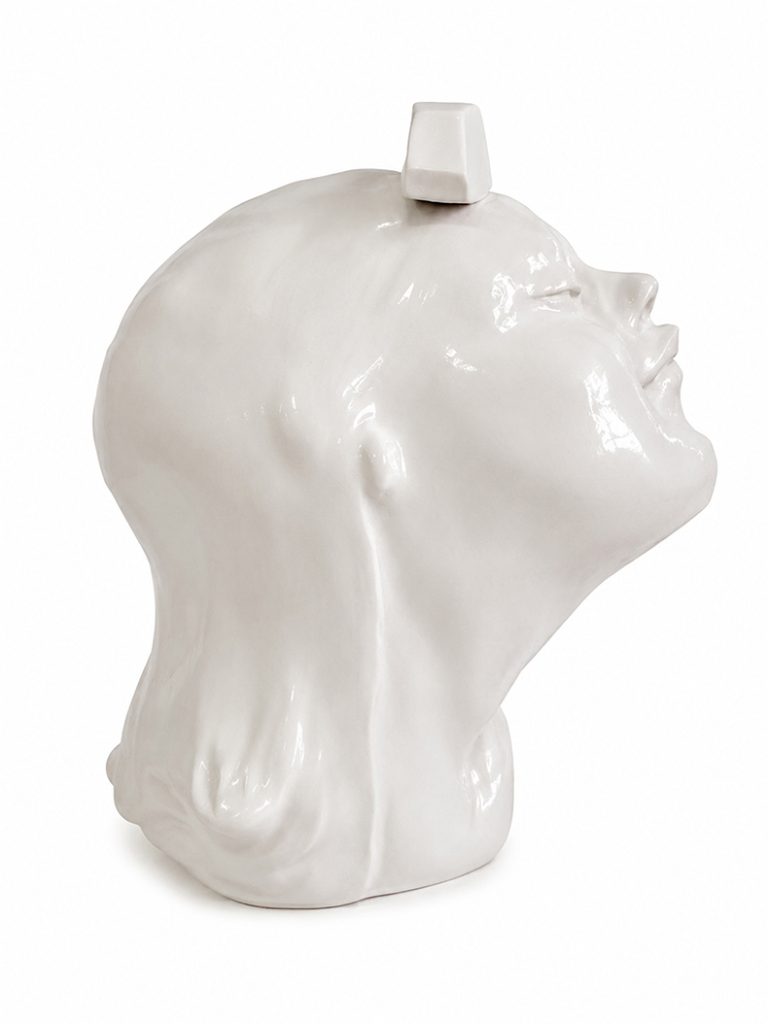
Landscape with Tulips, 2026, glased stoneware, 34x28x37cm
The exhibition features authentic ostraka from ancient ostracism procedures, bearing inscribed names of prominent political figures of ancient Athens, such as Themistocles, Aristides, Cimon, Nicias, and Alcibiades. These archaeological artefacts enter into dialogue with works by forty contemporary artists who employ a contemporary visual language to comment on these shifting forms of exclusion.
The exhibition does not seek to equate the two eras; it rather aims to illuminate their tensions and analogies, encouraging critical reflection on the relationship between power, community, and exclusion. Through this encounter between past and present, ostracism emerges not merely as a historical phenomenon but as an enduring mechanism that redefines itself according to contemporary social and technological contexts.
Visitors are invited to reflect on their own position within these networks of inclusion and exclusion and to reconsider what it means today to belong or to be “ostracized.”